
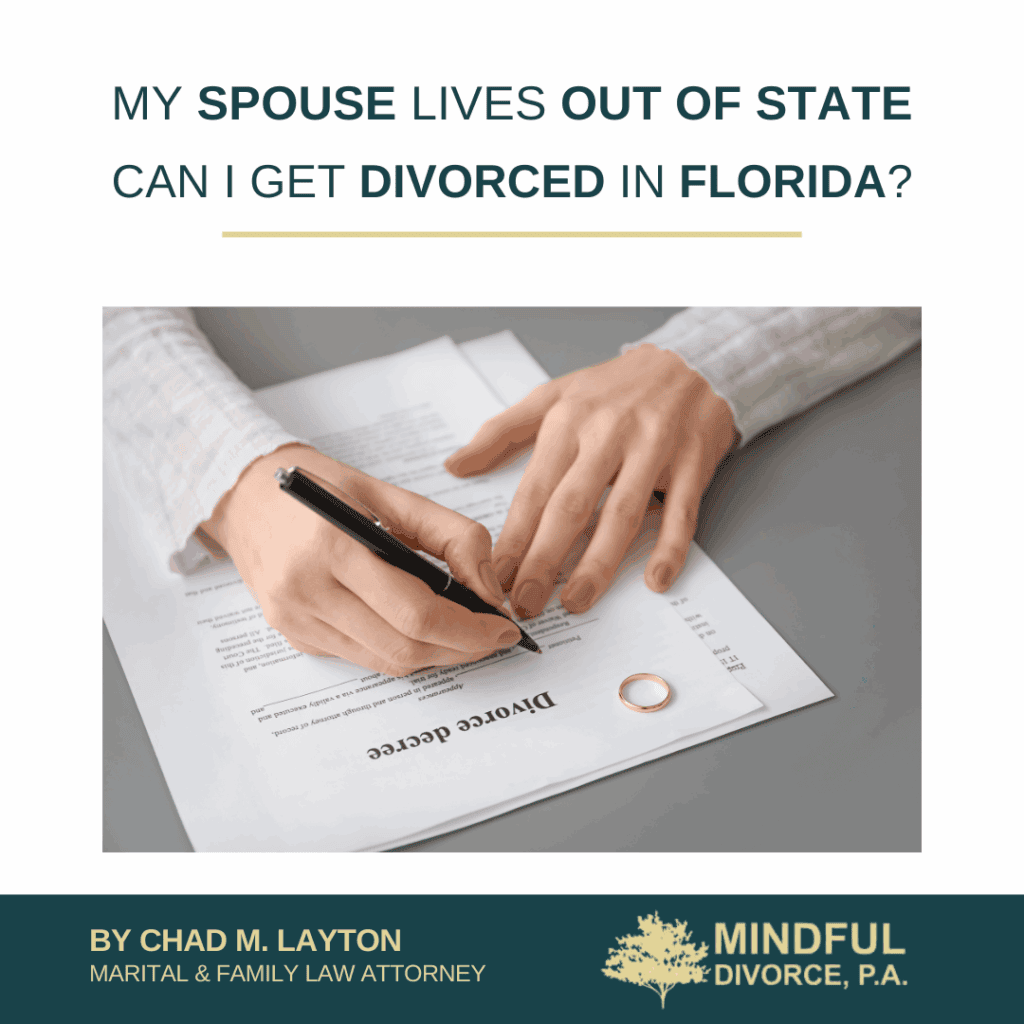
My Spouse Lives Out of State. Can I Get Divorced in Florida?
Living apart already strains a marriage, and long miles can make the legal process feel even heavier. If your spouse is across state lines, you may still be able to move forward in Florida with clarity and a plan.
At Mindful Divorce, P.A., we focus on peace of mind through clear steps and fixed-fee pricing, so you are not guessing about costs. This article explains how filing works when one spouse lives elsewhere, plus what to expect with property, support, and parenting issues.
How Florida Divorce Works When Your Spouse Lives Elsewhere
You can file for divorce in Florida even if your spouse lives in another state, as long as Florida’s residency requirement is met. Florida courts may be able to end the marriage, even if your spouse has never lived here.
The more complicated question is what else the Florida court can decide. Handling property, alimony, child support, or parenting issues can require additional legal authority.
Think of the case in two parts. First, the court needs authority to dissolve the marriage. Second, the court may need personal authority over the out-of-state spouse before deciding certain money, property, or support issues.
Meeting Florida’s Residency Requirements
Residency is the starting line, and it applies to only one spouse. If you have lived in Florida long enough, you may be able to file here even if your spouse lives somewhere else.
The Six-Month Rule and Acceptable Proof
Florida Statute Section 61.021 requires that at least one spouse has lived in Florida for six months before filing for divorce. Short trips away do not usually ruin continuity if Florida remains your home base.
The court may ask for proof of residency. Helpful records can include:
- A Florida driver’s license or state ID
- Florida voter registration
- Florida vehicle registration
- A lease, deed, or utility bill
- Proof of employment or mailing address in Florida
- Testimony or an affidavit from someone who knows where you live
Your out-of-state spouse does not need to meet this test. As long as one spouse qualifies, the divorce case can begin in Florida.
What Is Jurisdiction and Why Does It Matter?
Jurisdiction answers the question: What can the Florida court legally decide in your case? There are two types you may hear about, and each one serves a different role.
Subject Matter Jurisdiction Versus Personal Jurisdiction
Subject matter jurisdiction gives the court power to grant the divorce itself. In Florida, this comes from the residency rule noted above. If one spouse meets the six-month residency requirement, the judge may be able to enter a Final Judgment of Dissolution of Marriage ending the marriage.
Personal jurisdiction is different. A Florida judge may need a legal connection to the out-of-state spouse before ordering that spouse to pay alimony, child support, attorney’s fees, or certain money judgments. Personal jurisdiction can also matter for property and debt rulings.
Florida’s long-arm statute may apply in certain family-law situations, such as when the parties maintained a marital home in Florida or when the nonresident spouse lived in Florida before the divorce action. Personal jurisdiction can also exist if the out-of-state spouse voluntarily participates, waives objections, signs an agreement, or has other legally sufficient contacts with Florida.
Common facts that may support Florida jurisdiction include:
- The spouses lived together in Florida during the marriage.
- The out-of-state spouse previously lived in Florida before the case was filed.
- The parties maintained a marital home in Florida.
- The out-of-state spouse owns property or has other legally significant contacts in Florida.
- The out-of-state spouse agrees to participate in the Florida case or does not timely object to jurisdiction.
If those contacts are present, the court may be able to address money issues along with the divorce. If they are missing, the Florida court may still be able to end the marriage, but some financial issues may need to be handled differently or in another forum.
A short case review can help identify the best path before filing.
Florida Divorce With an Out-of-State Spouse: What Each Rule May Affect
| Issue | Can Florida Address It With Residency Alone? | When Additional Authority May Be Needed | Law Often Involved |
| Dissolution of Marriage | Often, yes, if residency is met | Usually, no personal jurisdiction is needed just to end the marriage | Florida residency law |
| Equitable Distribution | Sometimes limited without personal jurisdiction | Personal jurisdiction may be needed to bind a nonresident spouse or to decide certain property issues | Florida long-arm statute and equitable distribution law |
| Alimony | Usually, no, not against a nonresident spouse without personal jurisdiction | Personal jurisdiction is typically needed | Florida long-arm statute and alimony law |
| Parenting Plan and Time-Sharing | Possible if Florida has child-custody jurisdiction | UCCJEA rules determine whether Florida is the proper state | UCCJEA |
| Child Support | Usually requires personal jurisdiction or a proper interstate support process | UIFSA may help Florida and other states coordinate support | UIFSA |
If your case touches several states, careful planning can keep each issue in the right court and avoid repeat hearings.
Serving Divorce Papers to an Out-of-State Spouse
Proper service of process matters because your spouse must receive official notice of the case. The right method depends on where your spouse is located and what kind of relief you are asking the court to grant.
Proper Methods of Legal Notice
Service on an out-of-state spouse must follow Florida rules and any applicable law where service occurs. In many cases, this means using a sheriff, authorized officer, or certified private process server.
Possible service methods may include:
- Service by the sheriff or proper officer in the county where your spouse lives
- Service by a private process server authorized under the applicable rules
- Service through another method approved by the court or allowed by law
- Voluntary acceptance or waiver of service, if your spouse is willing to cooperate
If you cannot find your spouse after a diligent search, Florida may allow constructive service by publication as a last resort. This usually requires sworn proof of the steps taken to locate the person, followed by a legal notice in the required publication format.
Publication can allow the divorce to move forward, but it may limit what the court can decide. In many cases, money-related orders require personal jurisdiction, so publication alone may not be enough for alimony, child support, or certain property rulings.
Handling Parenting and Support Across State Lines
Parenting issues follow extra rules that respect where a child has been living. Two uniform laws help courts avoid competing orders across states: the UCCJEA for parenting matters and UIFSA for support.
UCCJEA and Parenting Jurisdiction
The Uniform Child Custody Jurisdiction and Enforcement Act, known as the UCCJEA, helps determine which state should decide parenting issues. In many cases, the child’s “home state” is the state where the child lived for the six months before the case began.
If the child recently moved, timing matters. A child may have a home state even if they are temporarily absent from that state. Courts can also communicate with each other when more than one state may be involved.
If Florida is the child’s home state, a Florida court may be able to decide parental responsibility and time-sharing. If another state is the home state, Florida may need to defer to that state for parenting issues.
UIFSA and Child Support
The Uniform Interstate Family Support Act, called UIFSA, governs interstate support issues. UIFSA helps states work together to establish, enforce, and modify child support orders.
If one parent lives outside Florida, UIFSA can help with service, income withholding, enforcement, and coordination between courts or agencies. The right support strategy depends on where each parent lives, where the child lives, and whether a support order already exists.
Child support across state lines can get technical, so it is important to use the correct process from the start.
Voluntary and Collaborative Options Across State Lines
Not every out-of-state divorce needs to become a courthouse fight. If both spouses are willing to cooperate, they may be able to resolve many issues through mediation, negotiation, or the collaborative law process.
These options can work even when spouses live in different states. Meetings can often happen by video, and agreements can be drafted and filed with the court when appropriate.
A spouse who voluntarily participates may also agree to certain terms or jurisdiction, depending on the facts and the documents signed. Still, cooperation should be documented carefully so the final agreement is enforceable.
Managing Dueling Petitions and Cross-State Complexities
Sometimes, both spouses file in different states. That can happen quickly when communication is strained or when each spouse believes a different court is better for their case.
Dealing With Competing Filings
When spouses file in different states, courts look at timing, jurisdiction, service, child home-state rules, and whether one court should defer to another. The answer is not always as simple as who filed first.
Child-related issues may be controlled by UCCJEA rules. Support may involve UIFSA. Property and alimony may depend on personal jurisdiction and the location of assets.
If you think your spouse may file elsewhere, moving quickly and thoughtfully can protect your position. A clear plan can prevent duplicate cases, wasted fees, and conflicting deadlines.
Get Clear Guidance on a Florida Divorce Across State Lines
When your spouse lives in another state, divorce can raise questions about residency, service, jurisdiction, parenting issues, and property division. At Mindful Divorce, P.A., we help clients sort through those issues with calm guidance and a clear legal strategy. Our fixed-fee approach also gives you predictable costs, which can make planning much easier.
If your divorce involves an out-of-state spouse, military service, parenting across state lines, or complex property concerns, call 561-537-8227 or visit our Contact Us page to schedule a consultation. We welcome your questions and are ready to help you understand the next steps with clarity and confidence.